Key facts
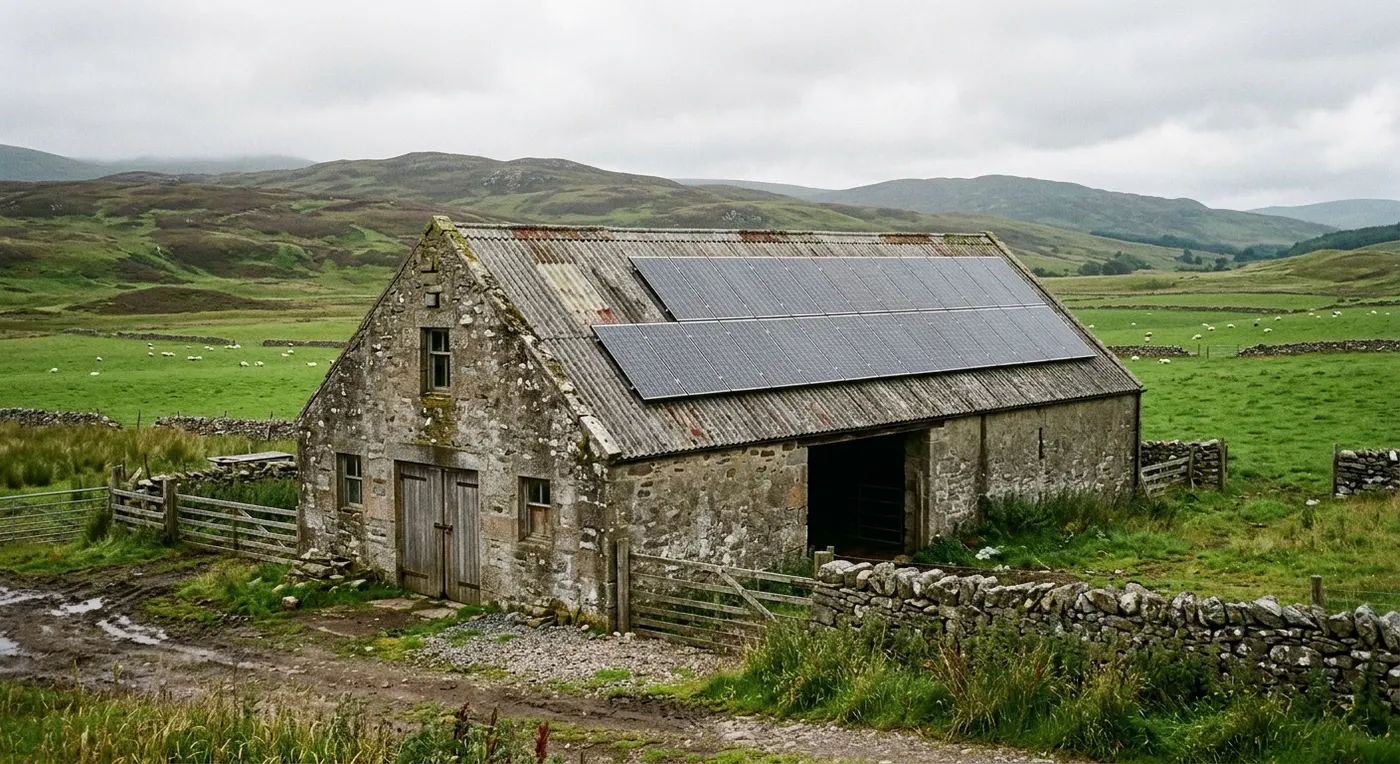
Last updated: 30 October 2026- Many Scottish farm roofs are fibre cement or asbestos cement and classed as fragile
- A structural survey checks whether the building can carry the extra load
- Options: fix to a sound roof, overclad, or re-roof first
- All work on fragile roofs follows HSE guidance HSG33
- No one walks an unprotected fragile roof
- We install through MCS-certified partners
- Last updated: 30 October 2026
Why farm roofs need extra care
A large share of agricultural buildings in Scotland were roofed with corrugated cement sheets, many of them containing asbestos if fitted before the 2000s. These sheets become brittle with age and weather, and they are classed as fragile: they will not reliably support a person's weight. Falls through fragile roofs are one of the most common causes of serious injury in agriculture, so the roof is the first thing we look at.
The structural survey
A solar array adds dead load from the panels and rails, and changes how wind acts on the roof. A survey looks at:
- The condition and type of roof sheeting, including whether it may contain asbestos.
- Purlin size, spacing and condition, and how the sheets are fixed to them.
- The main frame, whether steel portal, timber or older trusses, and any corrosion or rot.
- Exposure to wind, which is significant on many upland and coastal Scottish sites.
Where needed, a structural engineer confirms the loads in writing. Some buildings need extra purlins or repairs; a few are simply not suitable, and we will tell you that rather than force a design.
Options for asbestos cement roofs
Fix to the existing roof
Possible where the sheets are in fair condition and the structure is sound, using fixings designed to limit disturbance. Any work that disturbs asbestos must follow the Control of Asbestos Regulations 2012.
Overclad, then fit solar
New profiled metal sheeting is fixed over the old roof, encapsulating it. The panels then mount to the new sheets. This avoids removing the asbestos and gives a weathertight roof with a long life ahead of it.
Remove and re-roof
The most thorough option. Removal is carried out by appropriately trained and, where required, licensed contractors, with waste disposed of correctly. It costs more but leaves a new roof designed for the array. Re-roofing costs vary widely with building size and access, so we price it per job.
Our rule: if a roof is too fragile to work on safely, we find another method, such as a ground-mounted array, or we do not do the install.
Safe working on the day
Installs on fragile roofs are planned under HSE guidance HSG33 and the Work at Height Regulations 2005. That means edge protection or scaffolding, fall-arrest systems, crawl boards and spreader boards, and safety netting below where appropriate. Livestock and machinery are kept clear of the working area, and we agree access around your farm routine.
Planning and next steps
Solar on most agricultural roofs is permitted development in Scotland, subject to conditions on height, projection and listed buildings; we check this for you. To decide how large the system should be, read our farm solar sizing guide. For the electrical side, see grid connection and G99, and for costs, see farm solar finance. Quick answers are in the farm solar FAQ.