Key facts
Last updated: 30 October 2026- A battery stores surplus solar for early-morning milking or evening work
- Most larger Scottish farms have a three-phase supply — the battery must match it
- Sized on storage capacity (kWh) and power output (kW) from your usage data
- Standard grid-tied systems shut down in a power cut unless backup is specified
- Batteries are included in your G98 or G99 grid application
- Export-limited sites benefit most from on-site storage
- Last updated: 30 October 2026
What a battery does on a farm
Solar produces most in the middle of the day, while many farm loads fall either side of it. Without a battery, surplus solar is exported to the grid, usually at a much lower rate than you pay to import. A battery captures that surplus and lets you use it later, raising the share of solar you use on site.
- Dairy: shifts midday solar into early-morning and evening milking, cooling and washing.
- Arable: smooths dryer and fan loads that run into the evening during harvest.
- Diversified farms: covers evening demand from holiday lets, shops or EV charging.
- Export-limited sites: stores solar that cannot be exported where the local grid is constrained.
Sizing a farm battery
Batteries are sized on two figures: storage capacity in kWh, and power output in kW. Capacity should match the surplus your solar realistically produces on a typical day, not the largest summer peak. Power output should be enough to cover the loads you want the battery to run, such as a milk cooling compressor. A battery that is too big rarely fills; one that is too small leaves surplus unused.
Good to know: we model your half-hourly or monthly usage against expected solar generation before recommending a battery. If the numbers do not support one, we will say so.
Three-phase supplies
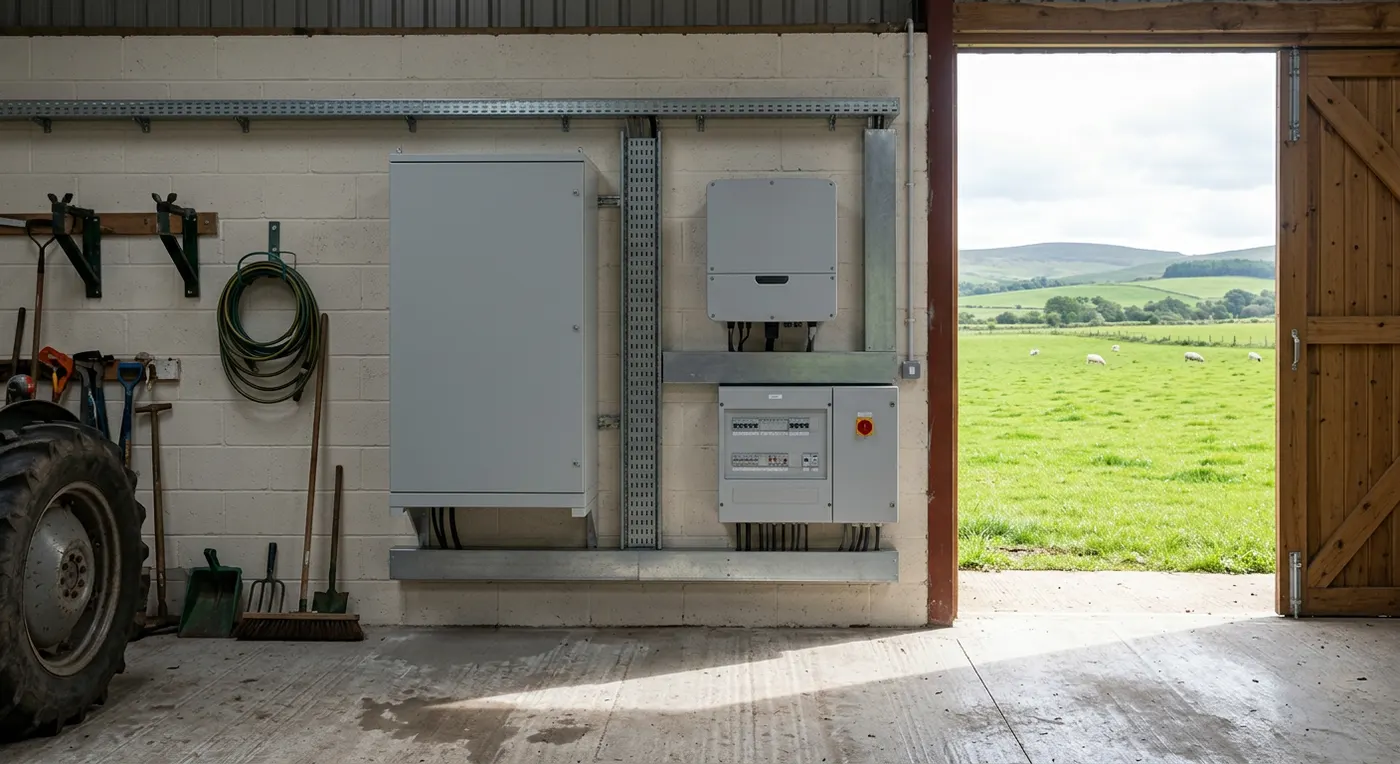
Most larger Scottish farms have a three-phase supply to run motors, pumps and dryers. Battery systems for these sites use three-phase inverters, or are designed carefully around how loads are spread across each phase. The battery, solar inverter and existing distribution board all need to work together, and the combined system is included in your grid application.
Grid rules and backup power
Batteries count towards your total generating capacity, so they are included in your G98 or G99 application to the network operator. Where export is limited, a battery helps you use solar that would otherwise be curtailed.
Standard grid-tied systems switch off during a power cut for safety. If backup matters, for example to keep milk cooling running, the system needs backup-capable equipment and is usually set to cover selected circuits only.
Location, safety and care
Batteries should sit in a dry, ventilated location away from livestock, dust-heavy areas and fuel stores, with clear access for maintenance. Monitoring shows how the battery is performing, and can be included in ongoing maintenance.
For a deeper look at battery systems across farms and estates, our sister site covers farm and estate battery storage in more detail. Part of the Scottish Energy Efficiency network.
Next steps
Start with the solar side in our farm solar sizing guide, or see ground-mounted arrays and agricultural roof solar. To pay for solar and storage, read about farm solar finance, or find quick answers in the farm solar FAQ.