Key facts
Last updated: 30 October 2026- SPEN covers central and southern Scotland; SSEN covers the north and Highlands
- Systems above 3.68kW per phase need a G99 application before connection
- G98 covers small systems up to 16A per phase — notified after installation
- Rural Scottish networks often have limited spare export capacity
- Zero-export designs use Engineering Recommendation G100
- Batteries must be included in the grid application
- Last updated: 30 October 2026
Why grid connection matters
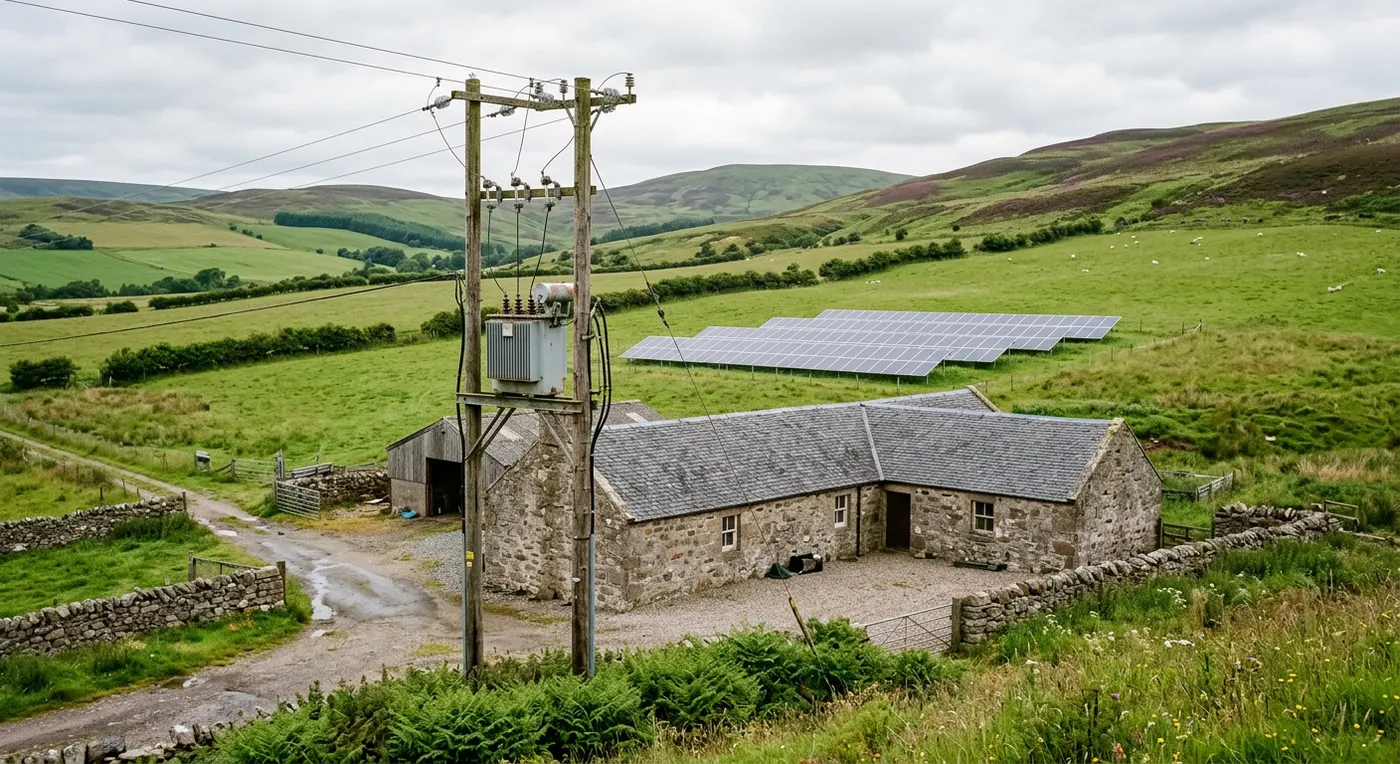
Any generator connected to your supply, including solar panels and batteries, can affect the local network. Network operators, known as DNOs, must know about it and, for larger systems, approve it first. Rural Scottish networks often run on long overhead lines with limited spare capacity, so the grid can shape what size of system is possible and how it is designed.
G98 or G99?
G98: small systems
Engineering Recommendation G98 covers systems up to 16A per phase, roughly 3.68kW on single-phase or 11.04kW on three-phase. These are notified to the DNO after installation. A few small farm systems fall into this category.
G99: larger systems
Anything above those limits, which includes most farm systems, needs a G99 application. The DNO reviews your supply, the local network and the proposed system, then accepts it, accepts it with conditions such as an export limit, or asks for further studies. Connection must not go ahead until approval is in place.
What goes into the application
- Your supply details, including MPAN, supply capacity and whether it is single or three-phase.
- The inverter and battery specifications, with their certification.
- A single-line diagram of the proposed system and how it connects to your board.
- The maximum export you are asking for, or confirmation of export limitation.
We prepare and submit this on your behalf and deal with any questions from the network operator.
When the grid is full: export limits and zero export
If the local network cannot take your full output, the DNO may offer a lower export limit, or a reinforcement cost to increase capacity. Often a better answer is an export-limited or zero-export design, where the inverter is set to match on-site demand so little or nothing flows back to the grid. This is covered by Engineering Recommendation G100 and can avoid long reinforcement delays.
Zero export still pays: the main value of farm solar is electricity you use yourself. Adding battery storage lets you keep more of the surplus that cannot be exported.
Timescales
G99 approval is often the longest single step in a farm solar project. Timescales depend on the network operator, the size of the system and how much spare capacity the local network has. Where studies or network works are needed, it can take considerably longer, which is why we apply early and set out the expected programme in your quote.
Next steps
See how system size is chosen in our farm solar sizing guide, compare roof and ground-mounted options, and read about farm solar finance. Quick answers are in the farm solar FAQ.